Showing posts with label G324 Research into target audience. Show all posts

Thursday, 23 November 2017

My Target Audience


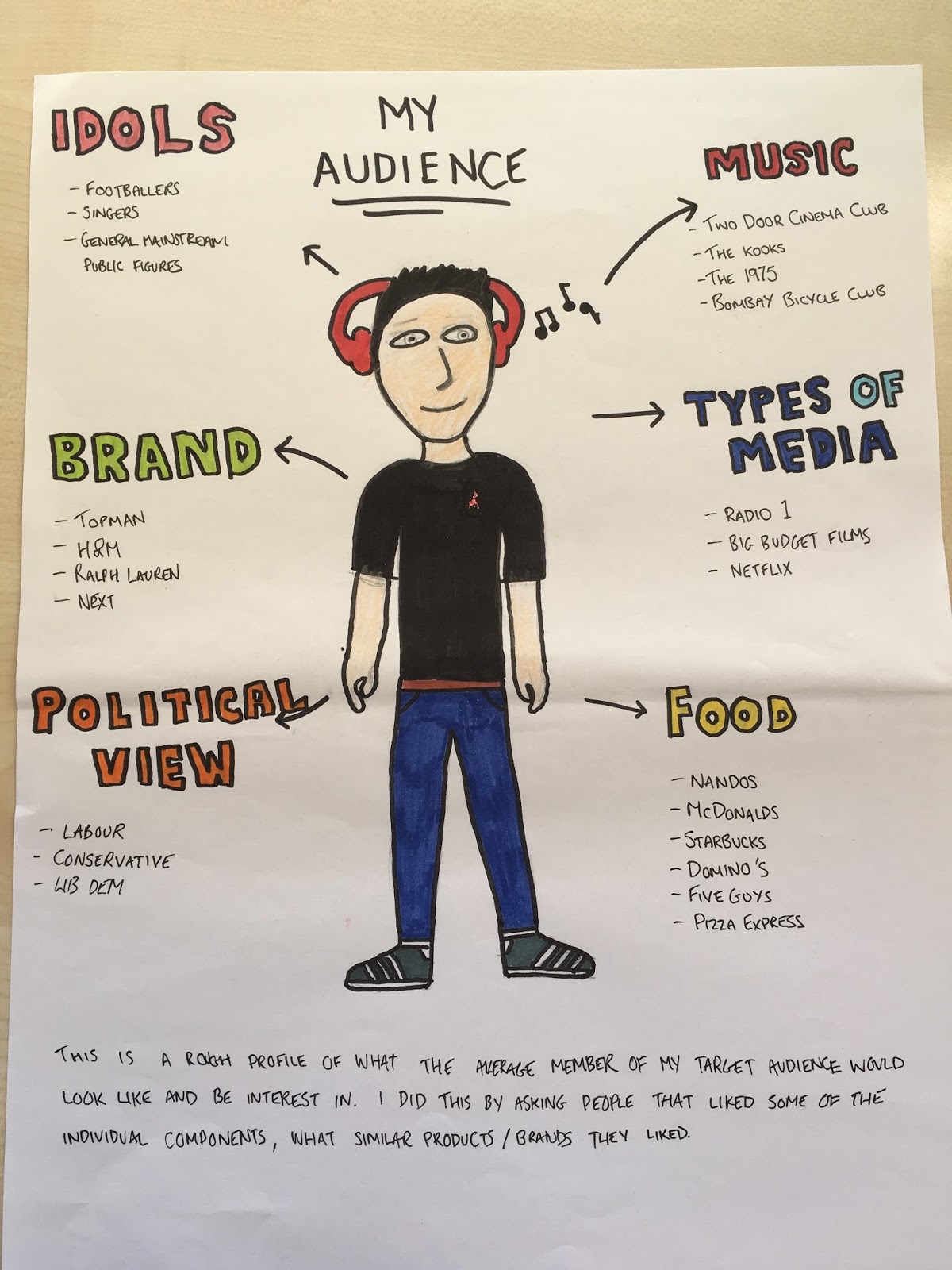
The demographic of the average member of my target audience would be males aged 18-24 and in the socioeconomic status of C2 -D - E according to YouGov Profiles LITE : https://yougov.co.uk/profileslite# 


Friday, 17 November 2017

How and why do media institutions profile audiences?


Media institutions profile audiences to give them a clearer understanding of who they are aiming their media products at.

Demographics

One of the methods a company will do this by is splitting audiences up into socioeconomic classes known as demographics. They are split into 6 classes; A, B, C1 , C2, D, E. The A class for high managerial persona like a company director. Someone that is usually on a £100,000 + a year contract.
Someone in the B class, could be in the administrative line of work or professional job employment.
In the C1 category, you might find a bank clerk or a junior manager of some sort that is responsible for only a very small team. C2 people are skilled manual workers like plumbers and electricians etc.
Someone that is categorised into the D category would be an unskilled manual worker like a farmer or packager, a job that requires little training and knowledge. Finally, category E is for the unemployed.

A strength of this is that it accounts for everyone and is an easily measurable method. This means they don't have trouble identifying who is who according to the chart. However the categories are extremely broad meaning there can be lots of different cultures and opinions in the categories, its not as if they all like the same things. Furthermore, it doesn't account for lifestyle choices made by the people within the classes. Thus making this a less favourable option due to negatives outweighing the positives.

Tribe/Subculture Model

The tribe and subculture model splits up today's youth into 5 main groups. The 5 being; Alternative, Mainstream, Leaning Edge, Urban and Aspirant. This model is slightly more specific about the interests of the consumers meaning it becomes easier to target products towards them due to them identifying as a group with more things e.g music. This is also good because the fact that it only targets teenagers means its more specific and easier to use for companies.
However this model also lacks the complexity and capacity to look in detail at the identity of audiences because there is no clear way of defining them without creating a database way to big. Furthermore it reinforces narrow minded stereotypes of youth showing them as only certain types of people.

Habits and Lifestyle

YouGov.co.uk made a survey system that classes people into groups based on common interests. It is extremely detailed for the person, telling you their socioeconomic status, rough age and other general demographics. It also states other interests that that person is likely to have. This makes it useful as companies can be thorough and get lots of background information on a group of people. However, similarly to the other methods it lacks the complexity and doesn't account for anomalies within that group. Not everyone is going to be the same and have similar interests. 
Thursday, 14 September 2017

What are the uses and implications of genre for producers and audiences?

There are many ways in which producers and audiences use genre. For example, producers can use genre as a set of codes for "guaranteed" success. Each genre will have similar themes to them meaning that when making a film a producer can stick within them themes so he or she knows that they will have achieved the main conventions of the genre. An example is a sci-fi film. If like all previous films you stick to the main focus points of things like; space, futuristic weapons/technology and one or two characters that have "unrealistic" qualities to them. 

Another way in which Producers will use genre is to reach different audiences. Most genres have a pre-existing audience, this gives producers a helping hand when it comes to perhaps switching genres or creating a hybrid genre because they can use the audience that is there all ready, find out what they want in a film and then build upon that so you have the groundwork for a successful film. As Christine Gledhill said "One advantage of genres meant different audiences could be identified and catered to, this made it easier to standardise production". Building on the second part of that sentence, it does make it easier to identify the demand for a genre when there is an existing audience which normally tend to be a mass audience because it means they can be very vocal in types of films they do and don't want which makes life easier for producers.


On the other hand, as Christine Gledhill further went on to say "Genre can be seen as 'a means of controlling demand', it can work the other way around. Genre can repeatedly use the same thing and predict what they audience want. An example of this is JK Rowlings 'Harry Potter' series and how they had the existing audience from the books but upon turning it into a film they were able to know what they audiences wanted and over the course of 8 Films built up their own 'brand image' of sorts and the audiences began to become familiar with repeating themes throughout. 

Then you have the audiences using genre. They use genre in a completely different way to that of producers. Audiences use genre as a way of identifying with someone of something. The best example is in music genres and how groups of people liking the same music form similar identities through the way the talk and dress. for example, a common identity associated with fans of death metal tend to be goths because they relate to the music and the artists. A theme with death metal is in music videos and when performing live the colour palette tends to be of dark colours and usually black meaning the fans then to make them selves feel part of a group to complete their identity then also wear dark coloured clothes.

Genres are increasingly shifting and changing, becoming hybrid genres which is where two different genres overlap to form one. An example of a media producer that does this is Ed Sheeran. his recent album crossed his usual acoustic pop sounds with Irish music to form a relatively unknown genre and because of this 'fresh approach' it has drawn in new and larger audiences to his already global fan base. 

So overall, genres get used by audiences and producers in different ways but they both compliment each other. Producers will use the audience of an existing genre when working out how to create their media product and the audience in return will guide them in the right direction. Almost like a small version of synergy.